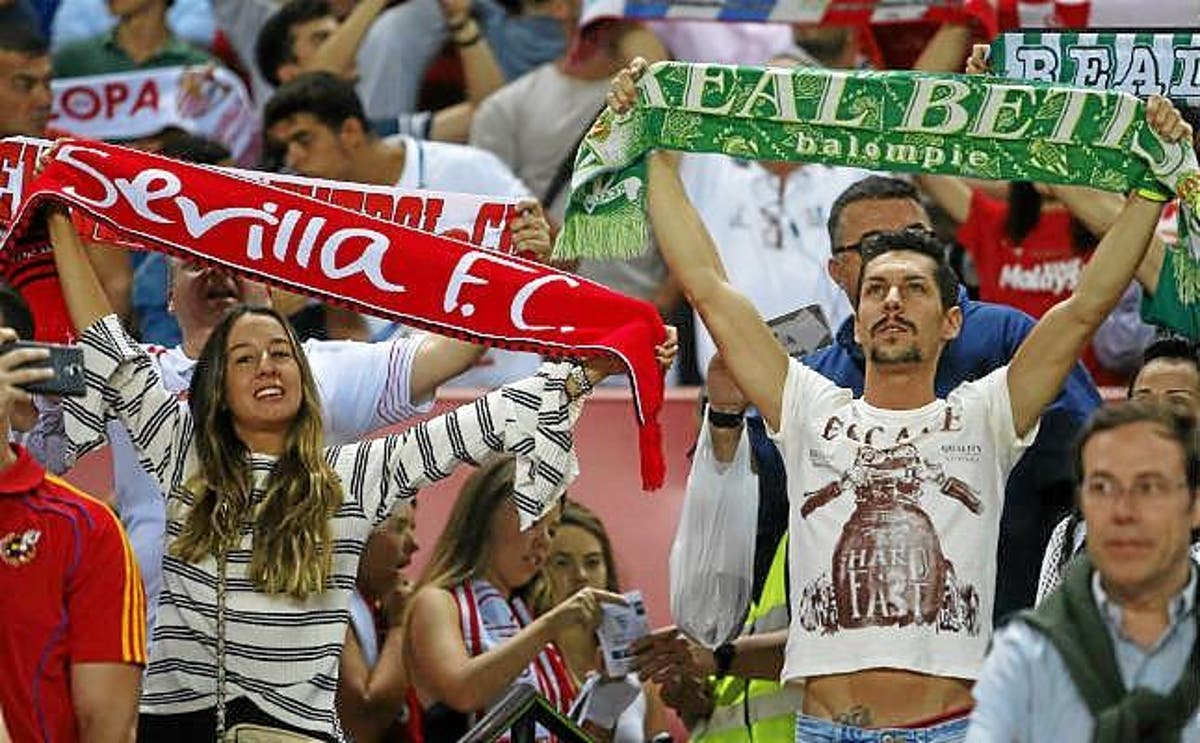
Seville is possibly the most ‘futbolero’ (football mad) city in all of Spain, which is saying something. With official figures showing that more than five per cent of its 700,000 population are fully paid-up members of one of its two LaLiga clubs, it’s no surprise that LaLiga is everywhere you look.
Both Sevilla and Real Betis are going through historically successful moments, so football both unites and divides the Andalusian capital as never before. Neutral supporters who spend any time in the city will quickly be asked to make the difficult choice between los rojiblancos (red and whites – Sevilla) and verdiblancos (green and whites – Betis).
Fortunately, both Sevilla and Betis play at stadiums easily reachable from the tourist and commercial centre of the city. A wander around the streets of the old town, or across the river Guadalquivir, will also help visitors decide which club’s story best fits their own.
Estadio Ramon Sanchez-Pizjuan
Dating from 1958 and named after Sevilla’s then club president, the Ramon Sanchez-Pizjuan is one of LaLiga’s most iconic home grounds, due in most part to the famous exterior mosaic incorporating the badges of many clubs who have visited over the years.
Inside, the Sanchez-Pizjuan has hosted a World Cup semi-final in 1982, and European Cup final in 1986. Refurbished most recently in 2015, when its modern red and white LED facade was added, the 42,714 capacity stadium thrums on game nights when the club’s fans sing its famous ‘casta y coraje’ (‘class and courage’) anthem.
On days without games, Sevilla FC RSP Stadium Tour takes visitors into the dressing room, press box and VIP zones. Exhibits in the SFC History Experience museum range from the club’s beginnings to the proud display of its record six UEFA Europa League trophies.

Estadio Benito Villamarin
Real Betis’ home stadium was opened in 1929 to host sporting events at the Ibero-American Exposition of 1929. Renamed in August 1961 after then club president Benito Villamarin, the stadium’s facade still incorporates the iconic ‘palm-tree’ geometric triangle shapes of its original Art-Deco style, which also feature in Betis’ club badge.
Recently expanded to seat 60,721 spectators, the ‘Villamarin’ is now LaLiga’s fourth-biggest stadium, and the matchday atmosphere created by the ‘verdiblancos’ both inside and outside the ground is an unforgettable experience.
Between LaLiga games, the family-friendly Betis Tour Experience brings visitors through the club’s history in an interactive audiovisual manner, before going behind the scenes to where the players and coaches prepare for games.

The Historic Old Town
Sevilla’s ‘Casco Antiguo’ is among the best-preserved medieval city cores in Spain, and those who get lost among its many winding streets will soon discover surprising football related sites and memories, as well as official club shops offering Sevilla or Betis game tickets, souvenirs, and gift ideas.
The Fuente de Hispalis fountain, located in the Puerta de Jerez square, is a symbol of the city and also where Sevilla’s fans celebrate their trophy wins. The nearby Cathedral, with its famous Moorish La Giralda tower, home to the ‘Virgen de los Reyes’ [Our Lady of the Kings] who is visited annually without fail by the rojiblanco squad. Calle Cervantes, near the Alameda de Hercules square, is where Betis were founded back in 1907.
La Giralda
The Giralda is a fabulous montage of the many centuries of Seville’s history that have come and gone. The monument’s confluence of different architectural styles reflects the cultures that have risen and fallen in Seville. The result, eclectic and remarkable, is fascinating.
Along the Avenida de la Palmera
Betis’ stadium was just one of many beautiful buildings designed by local architect Anibal Gonzalez for the 1929 World Fair, laid out along the stylish Avenida de la Palmera which still connects the city centre with the verdiblanco home. Among the splendid buildings, most of which are now open to the public as museums or galleries, is the Moorish Revival-style Plaza de España. This not-to-be-missed site is now possibly best known outside Spain as the filming location for blockbusters including Lawrence of Arabia and Star Wars: Episode II – Attack of the Clones.

Also close by is the Prado de San Sebastian, where the first recorded derby between Sevilla and Betis took place in 1915. Then a green meadow just behind the ‘Alcazar’ Royal Palace, it’s now the site of a busy bus station where many visitors from the airport embark.
Parque de María Luisa
Maria Luisa Park is the most famous park in Seville and one of its best sources of fresh air. Formerly the private gardens of the San Telmo Palace, the land was donated in 1893 by the Infanta Maria Luisa Fernanda de Borbón (the Duchess of Montpensier).
Across the river
Across the city’s Guadalquivir river is the Triana neighbourhood, where locals have allegiance to both Sevilla’s clubs. The 15th century Virgen de la Esperanza de Triana [Our Lady of Hope of Triana] accepted a floral offering from Betis club captain Joaquin Sanchez and his team during their visit at the beginning of the 2017/18 campaign. The bars and clubs on Calle Betis, right by the river, welcome all-comers late into the night.
Sevilla’s ‘third’ football stadium is the 60,000-seater multi-purpose Estadio La Cartuja de Sevilla, which hosted the 1999 World Athletics Championships, 2003 UEFA Cup final and EURO 2020, among many other sporting events.
Located between two branches of the Guadalquivir river, ‘La Cartuja’ island was previously home to a 15th century monastery where Christopher Columbus was once resident, which later became a world-renowned porcelain factory, and is now an art exhibition space and concert venue.
Seville is home to this, and so much more. The 36-metre-tall Torre de Oro (‘Tower of Gold’), originally a Moorish watchtower built during the 13th century, towers above the Guadalquivir river, and the city’s incredible flamenco and tapas culture is showcased on almost every corner.